Go wild with master naturalists in the natural state

If you enjoy exploring nature, whether it’s hiking, paddling, or learning about wildflowers, trees and critters, you’ll love going wild with area master naturalists.
“We’re a lively, friendly group of folks,” says Beth Kennedy of Mountain Home, president of North Central Arkansas Master Naturalists (NCAMN). “We volunteer to better appreciate all that the Ozarks have to offer, while also promoting and protecting nature in the natural state.”
NCAMN opened applications for new members on September 1. To learn more about what they do, you may email Kennedy at [email protected].
“New Master Naturalists learn about the Ozarks in classes that explore everything from archeology to zoology,” says Terri May of Mountain Home, who organizes classroom and field classes scheduled from mid-January to early May. “Our instructors are among the most knowledgeable in the state. Field work classes help them learn about how to take care of a hiking trail or evaluate streams in the White River watershed, for example. We are also planning several field trips.”
Master naturalists’ volunteer efforts revolve around preserving and promoting nature. They build and maintain hiking trails, assess water quality of area creeks, teach children and their families about nature, look after several pollinator and wildlife meadows and gardens, and assist partner agencies and organizations with other projects.
“For continuing education, we dig deep into a variety of related topics several times a year,” adds Kennedy. “The chapter also schedules purely recreational hikes for members beginning in this fall and continuing through spring.”
Trails
NCAMN’s trail team clears 75 miles of area hiking trails every year, working October through April, according to team leader Roy Stovall of Lakeview.
“This past year, we are helping build a section of the Ozarks Keystone Trail (OKT) on Norfork Lake at Dawt Mill. This trail will eventually connect Arkansas’s 270-mile Ozark Highlands Trail (OHT) to Missouri’s 240-mile Ozark Trail (OT),” says Stovall. “The OHT will be 350 miles, and the OT 340 miles when we finish the extension.
The Ozark Highland Trail (OHT) extends 240 miles through the Ozarks from Lake Fort Smith in west Arkansas to Lake Norfork east of Mountain Home. When complete the new trail will add another 50 miles to the OHT.
Streams
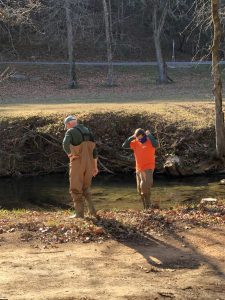
NCAMN’s stream team monitors water quality of seven creeks in Izard, Marion and Baxter Counties, according to stream leader Karen Woods of Flippin.
“Calico Creek is one of our favorite streams to assess,” says Woods. “We enjoy splashing in creek water and seeing what interesting creatures can be found and/or playing chemist with stream water. We are in Calico Rock every three months.”
Volunteers collect and analyze water samples and gather and identify macroinvertebrates (tiny bugs) to determine the relative health of stream waters that are part of the White River watershed. They send data they record quarterly on each stream to the Arkansas Game and Fish Commission (AGFC), which now has an extensive database of their findings.
Gardens
A new project in Calico Rock—a pollinator garden in old town—has been exciting for area volunteers.
” We put in two sets of pollinator plantings,” says team leader Jill Easton of Calico Rock, “one directly paralleling Rodman Avenue, the second a partially hidden shade garden below the parking lot.”
Master naturalists are also creating another new pollinator garden, this one on the site of Mountain View School District’s solar array.
” We will turn the five-acre solar site into a home and resting area for butterflies and other species by planting and nurturing native plants,” says Easton.
NCAMN has volunteered at Ozark Folk Center’s (OFC) Heritage Herb Gardens for 13 years, according to Donna Brocka of Mountain View.
“Besides tending plants in the gardens and greenhouse,” Brocka says, “we also learn a lot from OFC head gardener Tina Marie Wilcox. Almost every time we’re there she shares information with us about the historical and cultural uses of both native plants and others brought to the Ozarks by European immigrants in the 19th century.”
Gaston Wildflower Meadow in Bull Shoals-White River State Park (BSWRSP) near Lakeview is another garden project, according to meadow team leader Paula Caprio of Marshall.
“We have so much fun first researching native wildflowers and other plants, and then planting and nurturing them,” says Caprio.
Yet another team enjoys looking after native plant gardens on Buffalo National River properties, according to team leader Marilyn Fouts of Bull Shoals.
“During the growing season,” says Fouts, “we plant and take care of a demonstration garden at Tyler Bend Visitor Center and another at Buffalo Point Ranger Station.”
Kids
NCAMN’s Kids Team helps other organizations with nature education for children and their families, as well as developing their own programs, according to team leader Sally Brown of Lakeview.
“Fred Berry Center’s ‘Wild Wednesdays’ is one of our favorite summer activities,” says Brown. “In June and July, we assist AGFC staff with programs about mammals, birds, bees, snakes, and other critters.”
The team also creates “The Great Outdoors” during two summer days at Baxter County Library every summer and helps state park staff with programs offered in area public schools.
Agencies
NCAMN enjoys close partnerships with state parks and similar organizations. Besides the Ozark Folk Center State Park (see above), master naturalists also help out at Bull Shoals-White River State Park (BSWRSP) and Fred Berry Crooked Creek Nature Center (FBCCNC), an AGFC facility.
“We may weed the visitor center garden or paint fences and rails at BSWRSP,” says Karen Tietmeyer of Lakeview. “The park’s staff have been so helpful to us—providing classrooms and storage—that we really enjoy helping them in return.”
“We partner with folks at FBCCNC on several projects, and they provide classroom space and instruction for our members,” says Kathy Lasar Plapp of Yellville. “So, it’s quite gratifying to help plant, weed and mulch the native plant gardens, as well as paint and clean equipment and buildings.”
Applications
New members complete at least 40 hours of classroom and field training from mid-January to early May. They may begin volunteering with any of the teams right away. The application fee is $135, plus $30 for the first year’s dues, for a total of $165. The fee covers classroom materials and field trip expenses, according to May.
To join NCAMN, applicants first email chapter president Beth Kennedy at [email protected]. She will direct applicants to the online application, provide other information and answer questions.