River Lovenstein: A Heritage Broom Making Tradition
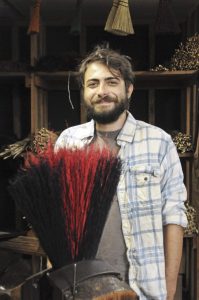
River Lovenstein has a vision for making brooms. It finds its roots in the traditional brooms that the Shakers made as well as those of his grandfather and grandmother, Jerry and Judy Lovenstein, of Grassy Creek Brooms. River, who is now 27, is the same age his grandfather was when he started to make traditional brooms as an apprentice at the Ozark Folk Center in Mountain View, Arkansas in 1978.
River’s interest in the craft evolved from a very early foray into broom making. As a five year old, he would take the broom corn stalks and cut them to make what he creatively called, “nail covers.” As a seven year old, he made miniature turkey wing brooms at his grandparent’s shop.
River’s journey into the creative traditional craft also led him to a three year apprenticeship with bead makers Tom and Sage Holland of Fox, Arkansas. This expanded River’s skill set and artistry. He learned so much from their expertise, but he found it difficult to make a livelihood.

He commented that the idea of continuing the legacy of his grandparents was important to him for several reasons. First, it appealed to his desire to be creative, instead of working a job just to make money. Also, the independence of making a living by his own hands, and not being just a cog in a corporate wheel, really resonated with him.
River values the process of making something that is both useful and beautiful, something that is sustainable and keeps him connected to the environment. As he puts it, “Instead of just using nature, I want to work with it and nurture it.” He spoke of how his grandfather has harvested the sassafras trees that they use for broom handles from the same grove for decades, taking what they need, while giving the trees time to regrow each year from the new shoots. The broomcorn is a totally renewable crop, and all of the work is done by hand, with traditional non-electric tools: the tying table, the “kick-winder”, the broom press, as well as hand-stitching the brooms and carving bearded “spirit faces” in the handles.
River spoke about the value of doing a mix of craft shows and also selling in retail shops. His experience of travelling with his grandparents to shows allowed him to experience first-hand the pleasure of meeting with other artisans, the friendships that creates, as well as the connections with visitors who purchased their craft.
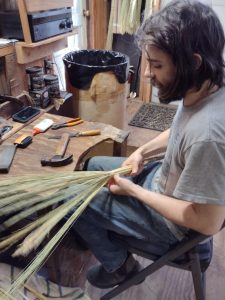
He feels that an advantage of starting this journey at 27 years old is that he has experienced a level of personal growth and maturity which in turn provides the ground for growth in his craft. River emphasized that the things which have become most important to him are those that prioritize the independence and freedom that the lifestyle of a craftsman can provide, well as the connection with both nature and the people he meets. This creates a livelihood which creates meaningful relationships on many levels.
The life of an artisan, a craftsman, is sometimes not a direct or easy path. Actually, it is usually neither direct nor easy. For someone to take that journey, it usually requires a willingness and desire to meet life on its own terms without expectations of “making it big.” River wryly remarked, “Well it may seem crazy to do this, but I’m not delusional, just an artist.” Indeed, he is. Returning to the broom making of his grandparents has truly been a homecoming full circle, one that bridges the generations and not only continues that tradition but enlarges it.
River’s work can be found at the Brick House Artisans in Leslie, Arkansas, and he will be participating in Mountain View, Arkansas Studio Tour this year as a new artist with Grassy Creek Brooms. Be sure to stop by and visit with him!